.avif)

It’s a chilly afternoon in Durham, NC, a few days after Christmas, and Duke is overcome with a refreshing stillness. In just a few days, the campus will be brimming with fans ready to watch the Blue Devils kick off their ACC gauntlet against the Georgia Tech Yellow Jackets. For now, though, most of Duke’s nearly 7,000 students are back home, squeezing the final breaths out of winter break. Not the men’s basketball team, though. They linger around Cameron Indoor Stadium. Breaks are limited on the road to greatness—and that’s exactly where this team appears to be headed.
No matter how you slice it, this year’s Blue Devils have all the makings of a team built for a deep run in the Big Dance, with a real chance to be the ones cutting down the nets come April. Heading into conference play, their sole loss was a 82-81 thriller at the hands of top-20 Texas Tech. Taking a look at the box score, it’s crystal clear why they didn’t pull out the victory: their star sophomore swingman, Isaiah Evans, had just 4 points on four shots. That sort of quiet night from Isaiah is the exception, not the rule.
A lot of the hype surrounding this year’s Duke squad is centered around freshman Cameron Boozer, the potential No. 1 draft pick in this year’s NBA draft. It’s similar to last year’s hype machine surrounding Duke’s Final Four run and eventual No. 1 pick Cooper Flagg. But it’s Isaiah, a former five-star recruit himself, who’s quietly emerged as one of the most lethal weapons in the nation.
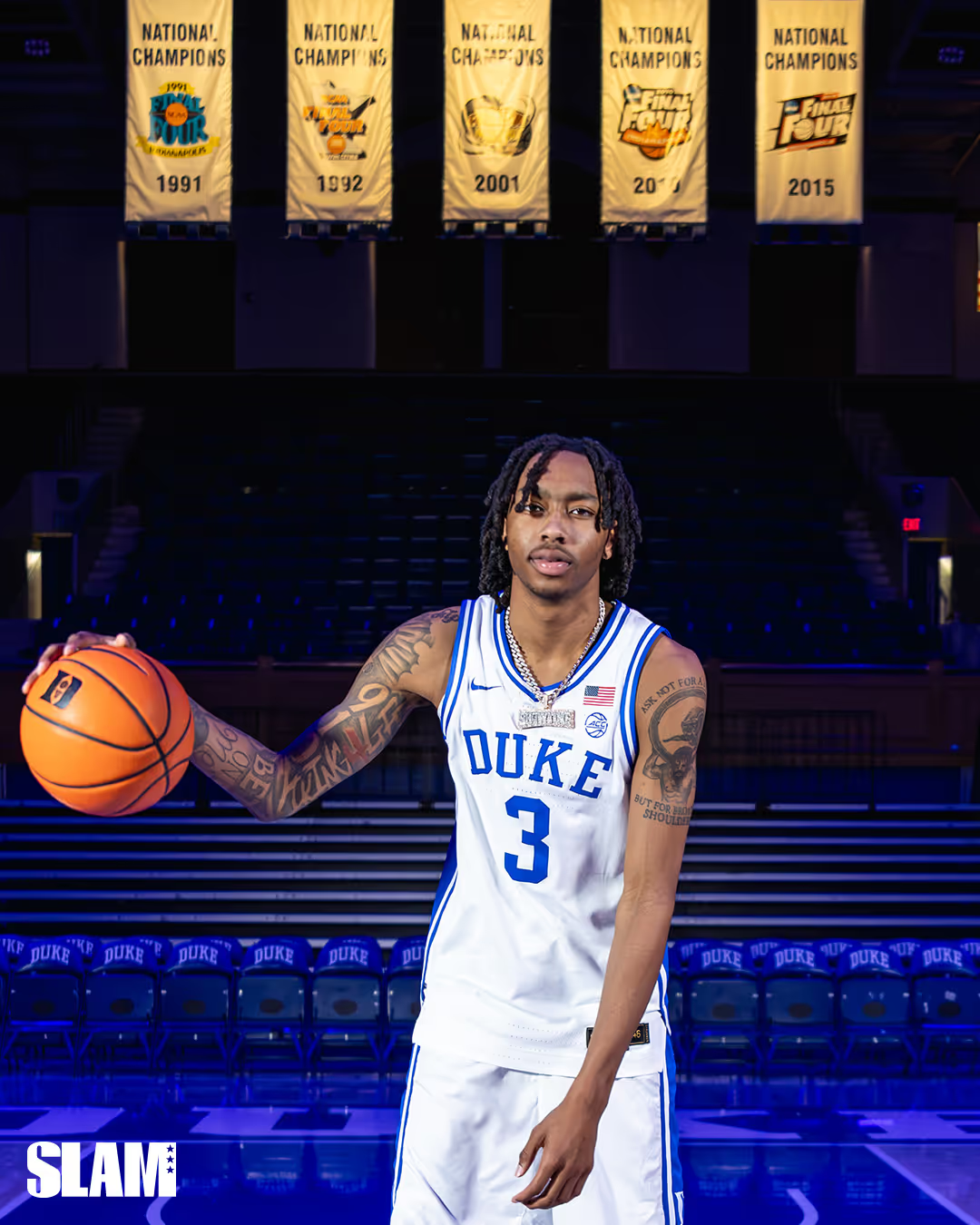

In many ways, Isaiah embodies everything that’s right about college basketball. As the sport barrels into uncharted territory—the chaos of the transfer portal, the warped eligibility rules, the multi-million-dollar NIL ecosystem—he feels like the last of a dying breed. His career, dating back to high school, has been defined by a word that’s become increasingly scarce in these times: loyalty.
“[Loyalty] has been a huge part of my journey, just on a personal level,” Isaiah says in a sit-down interview ahead of his SLAM U cover shoot. “Staying loyal to people who take care of you—and then just staying loyal to the process and to the grind. That’s what goes into most of my decision making when it comes to my life…I feel like I get the best results that way.”
As a freshman last year, Isaiah displayed glimpses of NBA promise, despite sporadic playing time. Some nights he logged 20-plus minutes, other nights he barely cracked five. He only started three games. For most five-star recruits, that would’ve been a one-way ticket out of town as soon as the season ended. But not Isaiah.
He entered the NBA draft to test the waters, with every reason to believe he’d hear his name called if he stayed in. His lifelong dream was right there. But instead of rushing it, he chose to come back, convinced his work in Durham wasn’t finished. “I feel like I had a lot of unfinished business after my freshman year,” he says. “I feel like I just had a lot more to prove and a lot more to offer.”
In the end, the decision came down to an honest conversation with his inner circle, and more importantly, with himself. Getting drafted was “not really the question,” he says. “The question was, Do you think that you’re an NBA player right now? And I sat back and I was like, Nah, I don’t think I’m an NBA player right now, I don’t think I can sustain in the League as of right now, I feel like I need another year to get ready.” Honesty and self-awareness—other rarities in today’s game.
To no surprise, Isaiah is a better player because of the decision to return. And so is Duke. With a year under his belt, he came back this year more refined. Physically, of course, but also mentally.
“Last year, I knew I could play. I just wasn’t as physically [as] ready as the other guys,” he says. “But [coming back] this year, I just felt way more physically ready and confident in my game.”

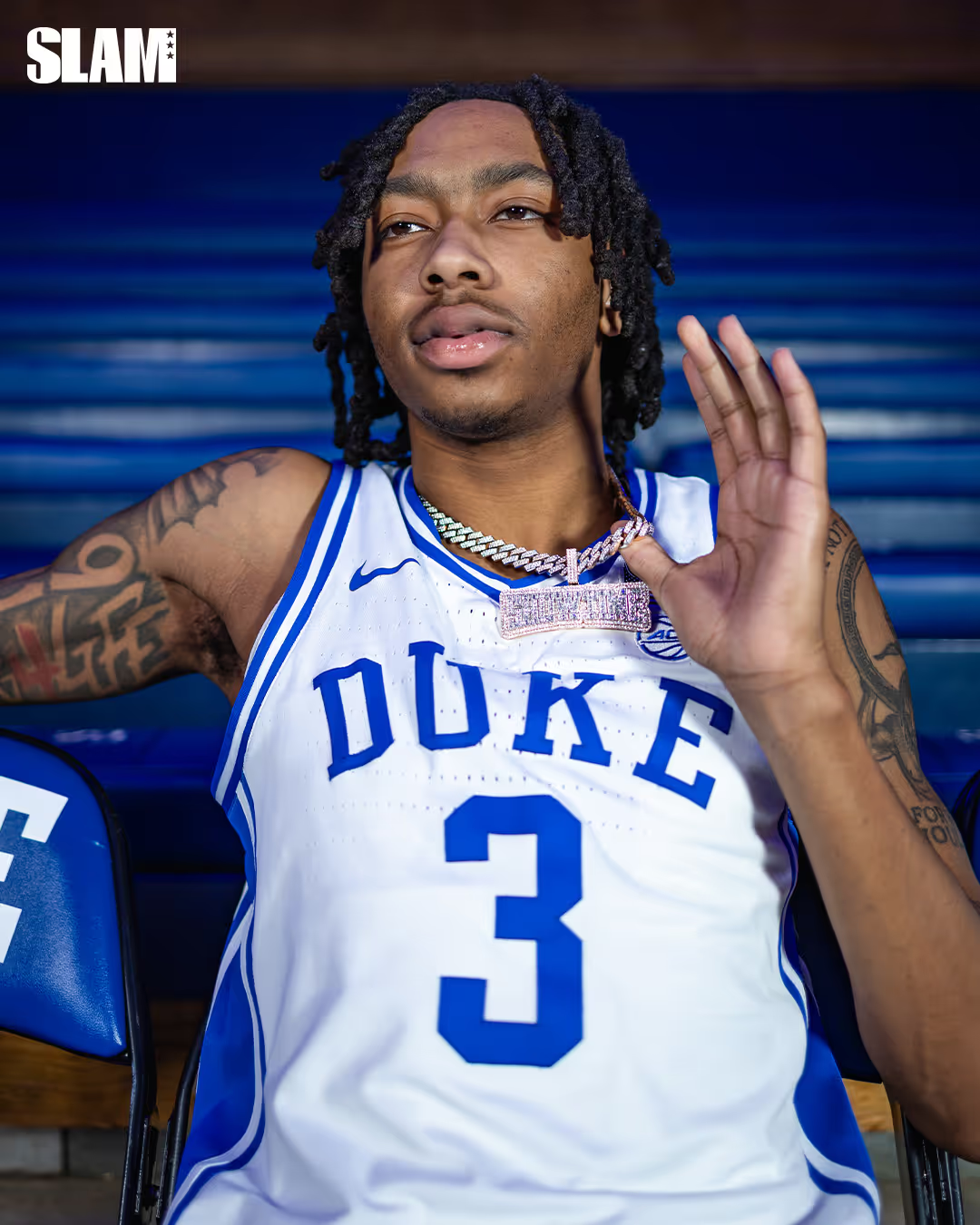
That confidence doesn’t just show up in his own stat line. It radiates outward to his teammates. In the moments when Duke’s offense stalls and the game tightens, he becomes the steady hand, creating a good shot out of nothing and giving his teammates something solid to lean on. When Duke needs someone to stop the bleeding or tilt the momentum back their way, Isaiah is who they trust to deliver. And sometimes, that steadiness shows up in a simple word of encouragement to a teammate.
“I’m real big on spreading the love. I always try to speak love to my teammates, because that’s how I feel,” he says. “If you’re a good, genuine person and you’re my teammate, it’s not going to take a long time for me to start building love for you. So I’m real big on telling people, Bro, you’re doing good.”
Isaiah tells a story about texting one of his teammates after realizing he missed him a couple of times on the break during a game. “It actually bothered me that I missed him that many times, because we came from the same issue of not playing a lot and just trying to get our flow going,” he recalls. “I know what it feels like to be wide open, trying to get my shots up, and feel like I’m being missed…I don’t want anybody to ever feel like I’m overlooking them or looking them off. I’ve never been that type of guy. I always want everybody to eat.”
Once again, hard to come by in the era of me, me, me.


But let’s be clear, Isaiah is going to make sure he has a full plate and finishes his food, too. Since that anomalous 4-point performance against Texas Tech, he’s steered the Blue Devils back on course, opening ACC play with three straight wins while pouring in 17, 28 and 23 points, respectively. He has a special ability to live in the now—to avoid dwelling on yesterday’s misses or getting distracted by tomorrow’s promises—because he understands how quickly it can all disappear.
“I feel like I see a lot of examples where things are going good, and it gets real bad, real soon,” he says. “The Most High wants to show me, I know where you want to go, but you have to stay composed and just trust the grind. I feel like if you look too far ahead, you might not be focused on the present. And I feel like you can lose sight or lose your opportunity.”
Still, there is one thing Isaiah allows himself to think about. Duke’s history is lined with some of college basketball’s biggest legends, and whether he leaves after this season or stays all four years, he’s already mindful of the legacy he’s building. When asked how he wants to be remembered as a Blue Devil, he doesn’t hesitate. “I definitely want to be known as a killer,” he says. “And I feel like I’m starting to carve that role out for myself.”
In the days that followed our shoot, he began to do exactly that. But on that quiet, brisk afternoon in Durham—campus empty, Cameron waiting, the ACC grind just around the corner—Isaiah Evans was already moving with that future in mind. Not chasing it. Not rushing it. Just locked into the work that would eventually make it real.
 SHOP COLLECTION